
Chamomile has been tied to bedtime for a long time. The modern question is narrower: does drinking chamomile actually improve sleep? The answer is not a clean yes or no. Some human studies report better sleep measures, while a small placebo-controlled trial in people with chronic insomnia did not find a significant benefit. Much of the research also uses concentrated chamomile extracts rather than an ordinary cup of tea.
Understanding the real scientific evidence helps separate bedtime folklore from verified clinical findings. To explore the broader nutritional and botanical context, see our complete guide on chamomile tea benefits, uses, and safety and learn the botanical origins in our article on what chamomile tea is.
The Older Reputation
Before clinical trials, chamomile was already one of the most commonly mentioned herbal sleep remedies. A 2011 Irish Times health article described its strong reputation as a natural sleep aid, while a 2013 Mayo Clinic Health Letter addressed the common question of whether chamomile tea really works as a sleep aid. Those articles are useful historical snapshots: the bedtime association was well established before the evidence base became clearer.
The Insomnia Trial
The 2011 randomized, double-blind pilot study enrolled 34 adults aged 18–65 with primary insomnia lasting at least six months. Participants received 270 mg of standardized chamomile extract twice daily or placebo for 28 days. The researchers found no significant differences in total sleep time, sleep efficiency, sleep latency, wake after sleep onset, sleep quality, or number of awakenings. [1]
That does not prove chamomile can never affect sleep. It does put a limit on the claim that chamomile is a proven treatment for chronic insomnia.
A Study That Actually Used Tea
A 2016 randomized study followed 80 Taiwanese postnatal women with poor sleep quality. Forty drank chamomile tea for two weeks and forty received usual postpartum care. The tea group improved on a physical-symptoms-related sleep inefficiency measure and on depression scores immediately after the intervention. At four weeks, the groups were similar again. [2]
This study is especially relevant to tea drinkers because the intervention was tea, not a capsule. It was also a specific group of women after childbirth, so the result should not be generalized to everyone with insomnia.
What Happened in Older Adults?
A 2017 randomized trial enrolled 60 adults aged 60 or older with poor sleep quality. The treatment group received 200 mg chamomile extract twice daily for 28 days. Sleep quality improved more than in the control group. [3]
Once again, the study used an extract and a defined dose. It does not tell us that a particular number of teaspoons of dried flowers will reproduce the result.
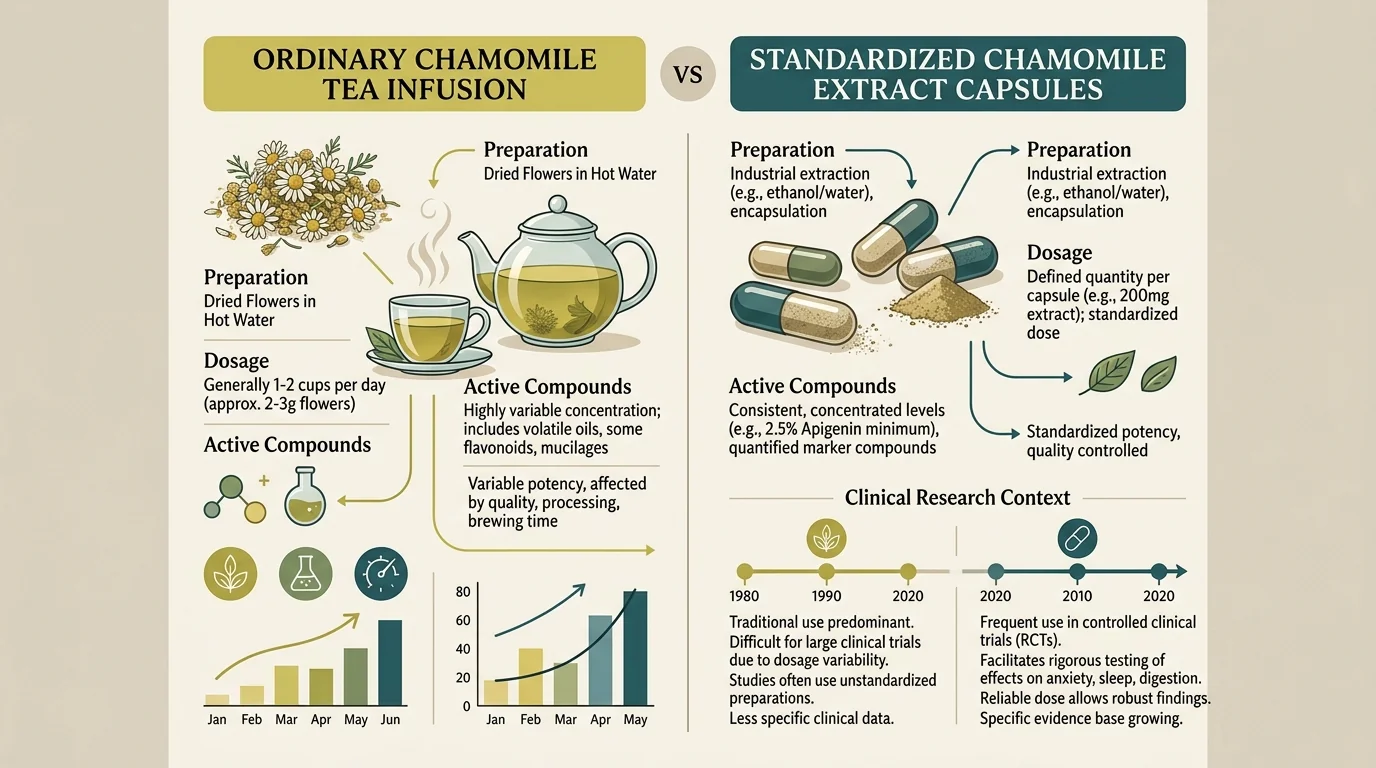
Figure 1: Comparing ordinary chamomile tea infusion with standardized chamomile extract capsules across preparation, dosage, and clinical context.
Why the Evidence Can Look Contradictory
A 2014 systematic review of herbal medicines for insomnia examined 14 randomized trials involving 1,602 participants. It concluded that there was insufficient evidence to support herbal medicines for insomnia. [4] A later 2019 review focusing on chamomile found a significant improvement in pooled sleep-quality measures, while the only direct insomnia trial still showed no significant change in insomnia severity. [5]
Those findings can coexist. Sleep quality and insomnia are different outcomes, and the studies were not all testing the same chamomile preparation.
What This Means for a Normal Cup
The fairest conclusion is modest. Chamomile has a reasonable place in sleep research, and some studies suggest improvements in sleep-quality measures. But that is not the same as a reliable sedative effect or a treatment for chronic insomnia.
A caffeine-free drink can also be useful as part of a quiet evening routine. If someone enjoys chamomile before bed and it fits comfortably into the routine, there is little reason to turn that simple habit into a medical claim. To optimize your nighttime habits, explore when to drink chamomile tea before bed and find out how much chamomile tea should you drink for sleep to prevent midnight awakenings.

Pure Himalayan Whole-Flower Chamomile Tea
Experience whole dried chamomile blossoms grown at high altitudes. Naturally caffeine-free with gentle floral notes, perfect for creating a restful, comforting evening wind-down routine.
When the Problem Is Bigger Than Tea
Persistent insomnia deserves attention of its own. If poor sleep lasts for weeks, causes significant daytime fatigue, or comes with symptoms such as loud snoring and gasping, restless legs, or major mood changes, a healthcare professional should be involved.
Tea can be part of the evening. It should not become a reason to leave an underlying sleep disorder untreated.
Safety
NCCIH says chamomile is likely safe in amounts commonly found in foods and teas, but allergic reactions can occur, especially in people sensitive to ragweed, chrysanthemums, marigolds, daisies, and related plants. Interactions with some medicines have also been reported. Pregnancy and breastfeeding warrant extra caution because safety information is limited. [6]
For a broader evaluation of daily health benefits, read our analysis on is chamomile tea healthy and discover whether chamomile tea makes you sleepy or simply promotes calm.
Historical Source Set Used for This Article
- Zick SM et al., 2011 — BMC Complementary and Alternative Medicine: chronic primary insomnia pilot trial. PubMed: 21939549 ↗
- Chang S-M & Chen C-H, 2016 — Journal of Advanced Nursing: chamomile tea trial in postnatal women. PubMed: 26483209 ↗
- Adib-Hajbaghery M & Mousavi SN, 2017 — Complementary Therapies in Medicine: chamomile extract in older adults. PubMed: 29154054 ↗
- Leach MJ & Page AT, 2015/2014 — Sleep Medicine Reviews: herbal medicine for insomnia systematic review & meta-analysis. PubMed: 25644982 ↗
- Hieu TH et al., 2019 — Phytotherapy Research: chamomile effects on sleep quality & anxiety systematic review. PubMed: 31006899 ↗
- O'Mathúna D, 2011 — The Irish Times: “Does it work? Can chamomile help promote sleep?” Irish Times ↗
- Mayo Clinic Health Letter, 2013 — “I've read that chamomile tea is a sleep aid— is that true?” Mayo Clinic ↗
- WebMD, 2012 — “Sleep Supplements: Melatonin, Valerian, and More.” WebMD ↗
- NCCIH (NIH), 2020 — “Chamomile: Usefulness and Safety.” NIH NCCIH ↗